

Whole-House Dehumidifier Installation in Florida
House sticky at the right temperature? Liberty Air and Electric installs ducted whole-house dehumidifiers across Florida.
- We size on the moisture load
- Attic install, dedicated return
- We tell you when you don't need one

Who a Whole-House Dehumidifier Actually Helps in Florida
Liberty Air and Electric installs ducted whole-house dehumidifiers across Greater Orlando and South Florida. And we're upfront when it's not the right call. So Liberty runs through the cheaper fixes for a sticky Florida house first, and dehumidifiers aren't part of the conversation until the ducts and the existing AC are looked at. Dehumidifiers can be a great solution, but we always make sure they are a great solution for you.
An AC only pulls water out of the air while the system runs, because the moisture condenses on a cold coil. That's why the temperature can be right and the house still feels sticky. There are five situations where a dehumidifier makes sense.
You keep the house at 78 and it feels damp
This is the one we see most. A higher setpoint means the AC runs fewer hours, and fewer hours means less humidity is removed.
The house isn't sealed well and you're not fixing that
Air leaks pull humid outdoor air in all day. If you aren't going to invest in sealing up your house, that's where a dehumidifier can step in to help out.
A small house with a lot of people in it
A lot of people don't realize it, but the folks living in a house are a big source of moisture. When there's a lot of people in a smaller space, a dehumidifier can be the only solution.
The AC is newer, right-sized, and still leaves the house sticky
When the equipment checks out and the ducts are solid, there's nothing cheaper left to try. That's when a dehumidifier is worth the money.
Towels stay damp
Humidity above 60 percent for weeks at a time shows up in bathrooms, paint, and wood floors. Your thermostat only tells you about your temperature.
The clearest candidate Liberty sees is a homeowner with a newer single-stage system, sized right, ducts in good shape, who likes the house at 78. Nothing about that setup is broken, and its setpoint is what's making the house damp. That system just doesn't run long enough to get humidity down to a comfortable level. Only a dehumidifier can do that.
Liberty Air and Electric sizes the humidity problem before quoting equipment
- We measure humidity against your setpoint and runtime
- We check duct capacity before we quote
- Solving sticky problems the right way
When Liberty Says Not to Buy a Dehumidifier
Liberty techs avoid dehumidifiers in three scenarios, and we see them often enough in indoor air quality work to bring them up before anybody talks about equipment.
The AC system is oversized
An oversized system cools the house fast and shuts off before it pulls much water out. Changing the tonnage means replacing the equipment, which is obviously a big expense. But it's often the best solution. Putting in a second machine to make up for it leaves the sizing problem and gives you one more thing to maintain.
An AC replacement is already on the horizon
Most of the humidity control comes from how the compressor operates. More stages means more dehumidification. This is why variable speed units control humidity the best. So if you're considering an AC replacement already, getting a variable speed unit is usually the better fix than getting a new basic AC and adding a standalone dehumidifier. You'll get lower monthly bills and a more comfortable house. The savings math on a Florida replacement shows the trade in dollars.
The ductwork is in rough shape
A leaking return duct in a hot attic pulls damp attic air into the system all day. So duct repair comes first, otherwise you're paying for a premium machine when tape, sealant and glue might've done the trick.
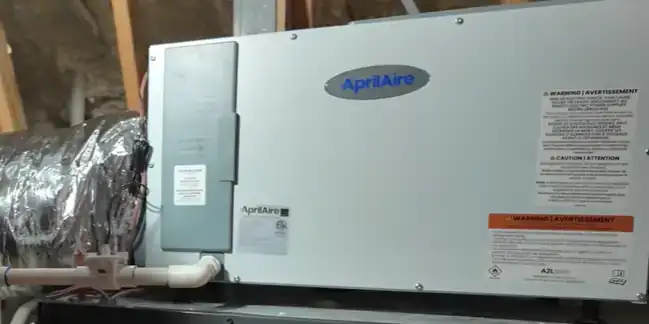
Liberty Air and Electric installs dehumidifiers as ducted units with a dedicated return. We run a new return duct to the dehumidifier so it pulls its own air, and we tie the dry air into the supply ducts that are already there. Then it adds comfort to the whole house whether the AC is running or not.
A whole-house unit adds roughly 200 to 300 CFM to a duct system, so we check to make sure the existing ducts can handle it. It's these duct modifications that can make the installation quote vary a lot from house to house.
In Wedgefield a lot of the housing stock went up between 2000 and 2012, and the original attic flex duct has had time to sag, separate at the boots, and lose its outer wrap. Duct in that shape isn't taking another 250 CFM until it's repaired.
House damp at the right temperature?
Book an assessment. We'll measure the humidity against your setpoint and runtime, check the duct capacity, and tell you if the AC or the ducts are the real fix before we quote a dehumidifier.
What Moves the Price of a Dehumidifier Installation
Whole-house dehumidifier installation runs $3,500 to $6,000 in Florida. The unit you install is not what really drives the price. It's the work required to support the dehumidifier and make sure it performs its best that sets the specific price.
These units go in the attic on most Florida homes, near the air handler. It's that attic work that makes the job hard. How much working room is up there decides how fast the install goes and sometimes whether the unit fits at all. New ducts, new control circuits, new drain lines. To avoid water damage, the drain line is especially important.
Liberty installs Santa Fe dehumidifiers on most of these jobs and AprilAire units on the rest. Pricing is rarely impacted by brand and sizing. It's all about the support work and labor.
How a Whole-House Dehumidifier Gets Sized, and Why the Pint Rating Misleads
Dehumidifiers are rated in pints of water removed per day. But the quoted number rarely exists in a real house, since it's measured against very warm and very damp air.
Take the published ratings on a Santa Fe unit. At the older industry test point of 80 degrees and 60 percent humidity, it's rated 70 pints a day. At the Department of Energy test point of 73 degrees and 60 percent, the same machine is rated 52.45 pints. A conditioned Florida house at 75 degrees and 50 percent is drier than either test, so the unit usually pulls even less than that once it's in.
In practice, this is why we round up. It corrects for that gap in the ratings. And comparing pint numbers across brands doesn't tell you much unless you check which test point each one was measured at.
Proper sizing works off the latent load, the moisture load, out of a residential load calculation instead of square footage. Manual J is the ANSI-approved standard for that calculation, and Liberty runs it on replacements. It counts the moisture leaking in through the envelope and the moisture the people inside put out showering and cooking. So a leaky house and a house full of people can end up needing the same size unit for different reasons.
Even with the load calculation, somebody still has to make a call. More space and more people push toward a 120 pint unit where a smaller house takes an 80, and Liberty rounds up when it's close. How dry the house ends up depends on how the people in it live, and a load calculation can't account for that ahead of time.
What a Variable-Speed System Changes Besides Your Power Bill
The calculator runs the savings for your own house. The comfort side has to be measured, and it comes down to what happens when a compressor slows down and keeps running instead of shutting off. It changes the humidity, the noise, and how far a room drifts between cycles.
Humidity
In side-by-side lab testing, the same AC held indoor humidity at 50 to 52 percent on summer days when it ran in variable-speed mode, and 55 to 60 percent when it ran as an ordinary single-stage system. A Florida Solar Energy Center test house came out the same way, with the variable-capacity system holding daily humidity about seven points below a fixed-capacity unit. In your house the gap depends on the system being set up to run long and slow, and that comes down to the install.
Noise
Outdoor units get rated for sound under AHRI Standard 270, so the numbers on two spec sheets are on the same scale. Common variable-speed condensers are rated 51 to 59 decibels at their lowest speed, and common single-stage condensers are rated 70 to 75 decibels. At full speed a variable-speed unit is rated 58 to 75 decibels, about the same as a single-stage unit. The quiet number is the low-speed number, and low speed is where the unit spends most of its running hours. A drop of 15 decibels is roughly half as loud to the ear.
Temperature swing
A single-stage system has one speed. It runs flat out until the thermostat is satisfied, shuts off, and the room warms back up until the thermostat calls again. A variable-speed system matches its output to the load, meaning how much cooling the house needs at that moment, and it keeps running as long as the house needs more than its lowest speed puts out. So there is no off period for the room to drift through. Manufacturers state that holds the house within about half a degree of the setting. Liberty techs see that on the systems they install, and often tighter, a few tenths of a degree.
Questions?
Frequently Asked Questions About Whole-House Dehumidifiers
Q: How much does a whole-house dehumidifier cost installed in Florida?
A: A whole-house dehumidifier costs $3,500 to $6,000 installed in Florida. The equipment is the smaller part of that range. Attic access, how much new duct the job needs, the length of the electrical run, and the length of the condensate drain line move the number more than the size of the unit does. A duct system with no spare capacity moves it further.
Q: Can a whole-house dehumidifier connect to my existing ductwork?
A: A whole-house dehumidifier connects to existing ductwork on the supply side, and gets its own new return duct so it pulls its own air. The unit adds roughly 200 to 300 CFM to the duct system, so it's important to make sure the existing ducts can support it. If not, those need to be adjusted.
Q: What size whole-house dehumidifier do I need?
A: Dehumidifier size comes from the latent load, which is the moisture load rather than the square footage. A load calculation splits it into air leaking in, moisture from people and cooking and showers, and moisture coming through the structure. Bigger space and more occupants push toward a 120 pint unit over an 80 pint unit, both read at the older 80 degree and 60 percent test point. Liberty rounds up in practice, because published pint ratings are measured in air warmer and wetter than the house being dried.
Q: Where does a whole-house dehumidifier get installed?
A: A whole-house dehumidifier usually gets installed in the attic in Florida homes, near the air handler. That's what makes the job hard. Everything the unit needs has to reach it up there, including the new return duct, a dedicated electrical circuit, and a condensate drain line.
Q: Will a variable-speed AC fix humidity instead of a dehumidifier?
A: A variable-speed AC does fix humidity for a lot of homes, and it is the better move when the system is already due for replacement. Variable-speed equipment runs long low-capacity cycles, and long runtime is what removes moisture. Buying a dehumidifier before a planned upgrade means overpaying for the same result.
Q: Do whole-house dehumidifiers need maintenance?
A: Whole-house dehumidifiers need a filter change and a drain check on the same schedule as the AC. The filter is the one people forget, because it's up in the attic. Because these units are usually in an attic, avoiding the leaks that come from clogged drain lines is really important.
Q: What indoor humidity should a Florida house hold?
A: A Florida house should hold 45 to 55 percent relative humidity year round. Above 60 percent for weeks at a time is where dust mites and mold grow.