

Florida's Same-Day AC Repair Experts
AC blowing warm, frozen, leaking, or won't turn on? Liberty Air and Electric diagnoses same-day, quotes upfront, and fixes every major brand from the truck.
- Same-day AC service available
- 90%+ of repairs done on the spot
- Service fee waived with repair

Signs It's Time to Call Liberty for AC Repair
Liberty Air and Electric finds what caused the failure, not just the part that quit last.
Cooling depends on air moving, refrigerant moving, and the electrical parts holding up.
Sometimes the problem is obvious. The house is hot, the air feels warm, or the outside unit won't start.
Other times the AC still runs and something just feels off. One room never cools down. Or it's an AC that runs all day. The thermostat says 74 and the house still feels sticky. You want indoor humidity between 45 and 55 percent, and when the air feels heavy like that, it's sometimes a humidity or air quality problem with the equipment working fine. If it's an indoor air quality issue and not a repair, we'll say so.
We won't know for sure until a tech is on site, but here's what each one usually means and what we check first.
My AC is blowing but not cooling
Most of the time it's a weak capacitor or a dirty coil choking off airflow. Less often it's a low refrigerant charge from a leak, or a compressor starting to give out. The fix is different for each one, so an AC running but not blowing cold air gets its own walkthrough. We test pressures, airflow, and the electrical parts before we call it.
My AC won't turn on
Nothing happens when the thermostat calls for cool. Check the basics first. Thermostat set to cool with fresh batteries, the breaker, and the float switch on the drain line, which shuts the system off on purpose when that line clogs. If those are fine, it's usually a capacitor, contactor, or control board, and those need a meter on them.
My AC is iced up
Ice on the copper line or the indoor coil almost always means low airflow or a refrigerant problem. A dirty filter or coil starves the system of air and the coil freezes. A low charge does the same. Turn the system off and let it thaw before we come out, because running it frozen is hard on the compressor and we can't read it accurately until it clears.
My AC is making a weird noise
Buzzing or humming points to electrical, usually a capacitor or contactor. Rattling or grinding is a motor or a loose part. Screeching is a bearing, and a hard banging can be the compressor. None of them get better on their own, so it's worth a look before that part takes something else out with it.
There's water around my air handler
Standing water or a steady drip is almost always a clogged condensate drain line. Buildup blocks the line, water backs up, and the float switch shuts the system down before it floods the air handler. Once in a while it's a cracked pan or a frozen coil melting off. We clear the line, check the safety switch, and make sure it drains the way it should.
My AC smells like it's burning or musty
A burning or hot-electrical smell is the serious one. Shut the system off and call, because that can be a motor, a capacitor, or wiring overheating, and it isn't worth the risk. A musty smell is different. That's moisture and mildew, usually a dirty coil or a slow drain holding water. We check the electrical side along with the equipment to find the source.
My AC keeps cycling on and off
Short cycling is the system turning on and off every few minutes without really cooling, and it wears parts out fast. Most of the time it's a clogged drain line tripping the float switch. Easy fix. But it could also be a dirty filter or coil, or a thermostat reading wrong. A low refrigerant charge does it too, and so does a system that was oversized from the start. On an AC that keeps turning on and off, how long each run lasts points to the cause. When the cycling stops and the system just stays off, an AC that won't turn on is usually a safety switch that finally latched. We find the cause before it costs you the compressor.
My outdoor fan isn't spinning
The unit hums, the fan on top sits still, and the house stops cooling within the hour. We test the run capacitor before anybody talks about a motor, because a weak capacitor does this same thing for a fraction of the cost. When the capacitor reads fine and the fan still won't turn, fan motor replacement is the next call, and it's worth asking what the compressor looks like before you approve it.
My AC has ice on it
Ice on the indoor coil or on the copper line means airflow or refrigerant, and the first check costs nothing. Pull the filter and hold it up to a light. Set the cooling off and the fan to on either way, because a system left running frozen sends liquid back to the compressor. The other causes of an AC freezing up include a collapsed duct and a filter upgrade that makes it worse.
My thermostat screen is blank
A blank screen usually means the thermostat lost power. Sometimes that's dead batteries. Sometimes the float switch tripped on a clogged drain line and cut power on purpose. A blown low-voltage fuse or a wiring problem can do it too. Put fresh batteries in first, and if it stays dark, a thermostat that isn't working has a short list of usual suspects before we get into the low-voltage side.
You don't have to know what failed before you call. Just tell us what you're seeing, hearing, or feeling. That's usually enough to start in the right place.
Liberty Air and Electric is here 24/7 to get you cooling again
- Same-day service available
- Repairs for all major AC brands
- Service fee waived with completed repair
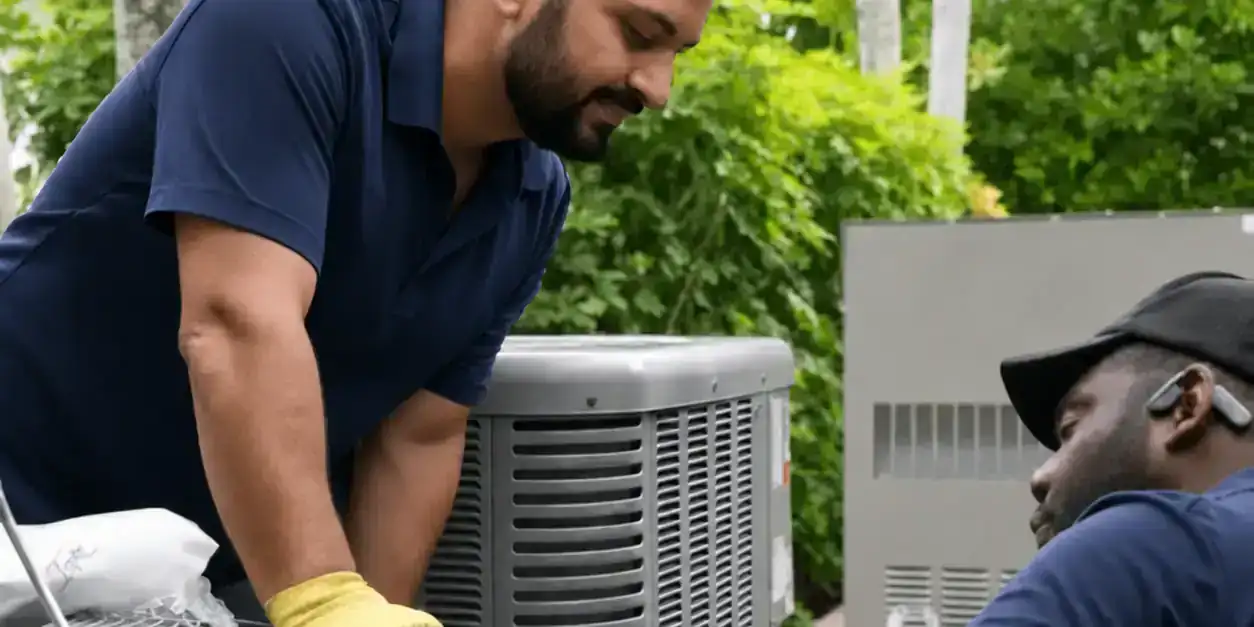
Florida systems fail in a few predictable ways. Long run times wear parts out, humidity is hard on coils and drain lines, and storms and voltage issues take out motors, capacitors, and control boards.
These are the repairs we see most often, with real Florida price ranges so you know what you're walking into.
Refrigerant Leak Repair
$200 - $1,500We use electronic refrigerant leak detection on R-410A, R-454B, and older R-22 systems. On an older system, we'll tell you whether the repair makes sense or whether the refrigerant cost makes AC replacement worth comparing before you spend more money on the unit.
Minor Electrical Repair
$75 - $450Capacitors, contactors, fuses, and the small electrical parts that keep your AC running. These are the most common repair calls we get, and a capacitor that died on the hottest day of the summer is the one we see most. Florida systems cycle nearly year-round, so AC capacitor replacement lands on a three to five year clock here. Same-day fix in most cases. No parts orders.
Coil Replacement
$900 - $3,500Evaporator and condenser coil replacement. Coils get leak-prone as systems age, and faster than that on the coast or in a high-humidity house. Warranty status matters a lot on these, so we check coverage before we quote the job. A coil that's dirty but not leaking is a different call, and a proper coil cleaning costs a fraction of a replacement.
Motor Replacement
$500 - $2,800Blower and condenser fan motors. Storms, voltage issues, and long summer runtimes are hard on these parts. Warranty motors land at the low end. We carry the common PSC and ECM motors and source brand-specific parts quickly when we need to.
Compressor Replacement
$1,100 - $3,200The priciest single part in your AC. Warranty status splits the range. $1,100 to $1,800 all in with the part covered, $1,900 to $3,200 without. On systems past 10 years old, a compressor quote is usually where it makes sense to compare the repair against AC replacement options before you decide. And AC compressor repair starts with testing everything around the compressor, since plenty of condemned compressors turn out to be a weak capacitor.
Warranty AC Repair
Labor only on covered partsWarranty repairs change the math fast. If the failed part is covered by the manufacturer, you may still pay labor, refrigerant, diagnosis, and processing, but the part itself can be covered. We pull the model and serial number and read the manufacturer's terms before we quote it.
Ductwork and Airflow Problems
Price varies significantlyA lot of cooling problems start in the ducts. Crushed, collapsed, or undersized ductwork raises static pressure and makes the blower work harder than it should. Over time that wears out the blower motor and shows up as repeated AC repair calls.
Ripped, disconnected, or poorly sealed ducts do something different. The system loses conditioned air before it reaches the rooms, so the AC runs longer to satisfy the thermostat. Long run times drive up bills, make humidity harder to control, and in the worst cases put extra wear on the compressor.
So when the airflow is weak and a room stays hot, we look at the ducts before we condemn anything in the equipment.

Liberty Air and Electric prices every AC repair on four things. Warranty status, system size, refrigerant type, and how hard the unit is to get to. You'll get a detailed quote before we start, and the numbers below are real rates for Central and South Florida. No surprise charges, no pressure to sign.
Typical Repair Ranges
| Repair Type | What's Included | Typical Cost |
|---|---|---|
| Diagnostic visit | Full system inspection, written findings | $49 - $99 |
| Minor repairs | Capacitors, contactors, relays, fuses, drain line flushes | $75 - $450 |
| Mid-range repairs | Blower motor, fan motor, control board, minor refrigerant leak | $450 - $1,400 |
| Major repairs | Evaporator/condenser coil, compressor, reversing valve, major leak repair with recharge | $900 - $3,500+ |
Every range above splits again by warranty status, and that split is usually the biggest number on the quote. The 2026 Florida AC repair cost guide prices all fourteen common repairs both ways, warranty and not, from our own job data.
Why Prices Vary Within a Range
Those ranges come from real differences in parts, labor, and how hard the job is. (Replacement is where AC quote prices vary the most, and the same equipment can come back with quotes thousands apart.)
Warranty vs. Non-Warranty: A Major Price Factor
If the failed part is still covered by the manufacturer, the parts cost comes off. You may still pay labor, refrigerant, diagnosis, and processing.
We check the model number, serial number, install date, and manufacturer terms before we quote warranty work. A covered compressor, coil, or motor prices very differently from the same repair out of warranty.
System Size (Tonnage)
A 5-ton holds more refrigerant than a 2-ton. Bigger coils, bigger compressor, bigger motors. That adds up on coil jobs, compressor swaps, and full recharges. Most Florida homes run 2.5 to 4 tons. Bigger homes or zoned setups go up from there.
Unit Location & Accessibility
An air handler in a tight Florida attic is real labor, especially in summer when attics hit 140°F. A condenser on a flat roof or inside a screened enclosure means extra setup. Coastal homes sometimes need the mounting pad replaced too, since salt eats through them. Ground-level garage air handlers are the easy ones.
System Complexity
Variable-speed and inverter-driven systems (Carrier Greenspeed, Trane XV, Lennox XC25, Daikin Fit) use fancier control boards, ECM motors, and proprietary metering. Parts cost more. Diagnosis takes longer. Single-stage systems are the simple ones.
Refrigerant Type
R-410A is still common in existing systems. Older R-22 systems cost more to service because R-22 hasn't been produced for new use since 2020. Newer equipment uses lower-GWP refrigerants like R-454B and R-32, and those need the right tools, training, and parts.
If refrigerant cost alone starts making the repair hard to justify, we'll tell you before you spend more money on the system.
If a Tech Says You're "Low on Refrigerant," Ask Where It Went
Refrigerant doesn't deplete, evaporate, or wear out. Your AC is a sealed loop. If the system is low, it leaked out somewhere. A fitting, a brazed joint, the evaporator coil, the condenser coil, or the line set.
A real diagnostic finds the leak. Some shops will quote a recharge ("just adding refrigerant") without finding the source, because top-ups are easier. You pay for refrigerant, the leak keeps going, and you call again next year, sometimes twice.
What to ask the tech before approving any refrigerant work:
- Did you find the leak, or are we adding refrigerant without finding it?
- How big is the leak, and what's the repair cost vs. a recharge?
- If the leak is in the evaporator or condenser coil, what does the warranty say?
On older R-22 systems the refrigerant has gotten expensive enough that the math sometimes points to replacement instead. We'll show you both numbers. Either way, we find the leak before anyone puts refrigerant in.
Want your exact repair price?
Book a diagnostic. We'll inspect the system, explain what failed, and give you the repair price before work begins.
When AC Repair Makes Sense
Repair usually makes sense when the system is newer, the failed part is isolated, and the repair cost is reasonable next to replacement.
A capacitor, contactor, drain line issue, thermostat problem, or minor motor repair is usually worth fixing if the rest of the system is in decent shape. Most calls end here.
Replacement is worth talking about when the system is older, the repair is expensive, or the same problem keeps coming back. Compressor failures, major coil leaks, repeated refrigerant issues, and old R-22 systems all push the math toward comparing repair against replacement.
The "$5,000 rule" is a quick gut-check. Multiply the repair cost by the age of the system. If the number is over $5,000, replacement is worth comparing. There's more to it than that, and why the $5k rule alone won't tell you whether to repair or replace goes through it.
We also look at:
- System age
- Repair cost
- Warranty status
- Refrigerant type
- Energy use
- Comfort problems
- How often the system has broken down
- Whether the system is sized correctly for the home
If repair is the right move, we repair it. If replacement is the better long-term call, we'll explain why and go through equipment options, financing, and warranty choices on the same visit.
How Liberty Runs a Florida AC Repair Visit
Liberty Air and Electric starts the repair before the technician pulls into the driveway. You should know when we're coming, who's on the way, and what happens next.
You schedule the visit
We set a 3-hour arrival window, then call when the technician is on the way.
We listen first
Tell us what happened. When the problem started, whether the air is warm or just weak, whether the thermostat went blank or the breaker tripped. Those details narrow it down before the truck rolls.
We check the basics
Thermostat, filter, breaker, drain safety switch, airflow, visible equipment condition.
We test the equipment
Depending on the symptom, we may test capacitors, contactors, motors, control voltage, refrigerant pressures, temperature split, amp draw, and safety controls.
We explain the finding
You should know what failed and what your options are. We explain the repair in plain English before any work begins.
We repair it when possible
Our vans are stocked for the repairs we see most often. That's why more than 90% of repairs are completed on the spot.
Ongoing warranty: Most repairs we do carry a 1-year workmanship warranty unless we say otherwise. A few items, like drain line flushes, can't reasonably be guaranteed that long, because buildup and site conditions change. For manufacturer-covered parts like compressors, coils, and motors, we check the coverage before we quote the job.
How Liberty Helps Avoid the Next AC Repair
No maintenance plan prevents every breakdown. Parts still fail, drain lines still clog, and Florida heat is hard on equipment.
Dirty coils, clogged drain lines, and weak capacitors are all easier to deal with on a tune-up than on a hot afternoon with the system already down. Same with loose electrical connections and airflow problems. When the coil itself is the problem, AC coil cleaning is its own visit, in place or pulled and cleaned outside where stronger chemicals can be used. A tune-up costs less than an emergency repair almost every time.
A regular HVAC maintenance plan keeps the equipment cleaner and gets a technician in front of the small stuff before it turns into a breakdown in August.
Why Homeowners Choose Liberty for AC Repair
Liberty Air and Electric is family owned, licensed for HVAC and electrical work, and insured. The techs are EPA certified and trained through factory and in-house programs, and every one of them is background-checked and drug-tested, so you know who's in your house.
EPA Section 608 is the federal rule on refrigerant handling. It covers recovery, charging, leak limits, and documentation. That's why a real refrigerant repair has paperwork behind it, and why the tech holding the gauges has to be certified. We don't cut corners on 608, and the shops that do are usually the same ones quoting recharges instead of fixing leaks.
Our techs average 7 years of field experience. We answer nights and weekends, and same-day service is on the table whenever scheduling allows.
You'll get upfront, flat-rate pricing before the repair begins, and that's still the price when the work is done.
Licensed for HVAC and electrical work
That matters when the repair runs into breakers, disconnects, wiring, controls, or replacement planning.
EPA-certified technicians
Refrigerant work has to be handled right.
90%+ repairs done on the spot
No waiting on a parts order for the failures we see most, so most repairs don't need a second visit.
Upfront, flat-rate pricing
You'll know the repair price before the work starts.
Liberty Repairs All Major AC Brands
Every AC does the same basic job. Move heat out of the house and keep air moving across the indoor coil. The parts, controls, and common failure points change by brand.
Liberty Air and Electric repairs all major AC brands, including Rheem, Carrier, American Standard, Trane, York, and Daikin. We buy direct from the distributors, so we can get parts, check equipment options, and move quickly when a warranty claim is involved.
Rheem AC repair
Rheem systems are common in Florida homes and usually straightforward to service. What we see most is Rheem blower motors, control boards, drain line problems, and the standard electrical parts.
Carrier AC repair
Carrier runs from basic single-stage units up to high-efficiency systems. Liberty Air and Electric buys Carrier parts direct from Carrier Enterprise and swaps in a generic blower motor when the factory part is on order. On those systems we handle capacitors, contactors, refrigerant leaks, thermostat communication problems, and airflow restrictions.
American Standard and Trane AC repair
American Standard and Trane share a lot of the same components, and the equipment holds up well. Liberty Air and Electric is an authorized Trane dealer, so residential Trane parts get swapped at the counter. As the system ages, the repairs are usually sensors, motors, compressors, airflow, or controls.
York AC repair
York shows up in houses and in light commercial. We work on the electrical parts, refrigerant issues, coil problems, and condensers that aren't performing.
Daikin AC repair
Daikin includes inverter-driven and ductless equipment, and those need a careful diagnostic. Communication errors, sensors, and controls get checked before anybody replaces a part.
No matter the brand, the repair starts the same way. Find the actual failure, explain the options, and fix what makes sense to fix.
Emergency AC Repair Availability
A no-cool call in Florida isn't something to sit on for three days.
Liberty Air and Electric answers 24/7 and runs same-day service. For urgent no-cool calls, our goal is to get to you in about 2 hours or less whenever scheduling allows.
Call right away if:
- Your AC is completely out
- The house is getting hot fast
- The breaker keeps tripping
- You see water near the air handler
- The system is frozen
- You smell burning or hear loud electrical buzzing
- Someone in the home is especially sensitive to heat
If there's an electrical smell, a repeated breaker trip, or an obvious safety issue, turn the system off and call. Don't keep resetting a breaker that keeps tripping. If the problem points outside the AC equipment, we can check the electrical side too.
Where Liberty Provides AC Repair
Liberty Air and Electric works most of South Florida and Greater Orlando. These are the areas where we're deepest on the ground.
Questions?
Frequently Asked Questions About AC Repair
Q: How fast can Liberty Air and Electric get to my house?
A: Liberty Air and Electric can get to most houses the same day, and we answer 24/7. For urgent no-cool calls, our goal is to get to you in about 2 hours or less whenever scheduling allows.
Q: Is the service fee waived if I approve the repair?
A: Yes. The service fee is waived with any repair. We'll explain the repair and the price before any work begins.
Q: Should I repair or replace my AC?
A: Repairing your AC usually makes sense on newer systems with an isolated part failure. If the system is older, leaking refrigerant over and over, breaking down often, or facing a major compressor or coil repair, it's time to compare the repair cost against AC replacement.
Q: Why is my AC running but not cooling?
A: An AC running but not cooling usually comes down to airflow, refrigerant, a dirty coil, a weak electrical part, a fan motor, or a compressor issue. A technician needs to test the system before calling it a refrigerant problem. And on refrigerant, if the system is low, it leaked out somewhere. Refrigerant doesn't deplete on its own.
Q: What does it mean if my AC is frozen?
A: A frozen AC usually means airflow is too low or the refrigerant side of the system isn't working right. Turn the system off and let it thaw before the appointment so the technician can get accurate readings.
Q: Can I clear my own AC drain line?
A: You can sometimes clear your own AC drain line with a wet/dry vacuum, one of the few AC problems some homeowners can try themselves. If the clog comes back, call for service, because the drain setup may need a deeper cleaning or a correction.
Q: Do you repair all AC brands?
A: Yes. Liberty Air and Electric repairs all major AC brands, including Rheem, Carrier, American Standard, Trane, York, and Daikin.
Q: Are your technicians certified?
A: All Liberty Air and Electric technicians are EPA certified for refrigerant work. Some technicians are also NATE certified.
Q: Do you repair heat pumps too?
A: Yes. Liberty Air and Electric repairs heat pumps too, and a lot of heat pump problems show up on the same equipment as the cooling side. If the issue shows up in heating mode, see our heating repair service.