

AC Refrigerant Leak Detection Across Florida
Low on refrigerant again after a top-off? Liberty Air and Electric tracks down AC leaks across Greater Orlando and South Florida.
- Every detection method on the truck
- Deeper searches quoted before they run
- Straight answers on repair vs. replace

How Liberty Finds an AC Refrigerant Leak
Liberty Air and Electric carries every leak detection method in the trade, and matches the method to the system instead of running the full menu on every call.
Refrigerant isn't fuel. It doesn't get burned off or used up, and a sealed system holds the same charge its whole life unless something opens a path out. So a system running low has a hole in it, and finding that hole is the whole job. Adding refrigerant without finding it buys a few weeks, then empties the next charge exactly the same way. Ask any tech who quotes a top-off where the refrigerant went.
Every one of these methods has its place, and we run them all as jobs demand. Each one costs time and money, so the right search depends on the system's age, its warranty status, and what the cheap checks already turned up. Sometimes the whole search is one look at an old coil.
Visual inspection
Refrigerant carries oil, and the oil comes out with it. A dark, greasy stain on the evaporator coil or a wet joint on a fitting is where the refrigerant went. It costs nothing to look for, and on an old system that stain is all the proof anybody needs.
Soap and bubbles
The classic. Soap solution brushed on a joint bubbles where gas is escaping. Cheap, fast, and still the best confirmation there is on an accessible fitting. It only works on suspects you can reach and see.
Electronic sniffers
Heated-diode and infrared detectors smell refrigerant in the air at parts-per-million levels. Liberty techs walk one across coils, joints, and valves to narrow a leak down to inches. Wind, dirt, and tight access can all fool them, so we confirm what they find before quoting anything.
Ultrasonic detection
Gas forcing its way through a small hole makes a hiss above what your ear picks up. An ultrasonic detector hears it. Useful where a sniffer struggles, like a windy pad or a spot with refrigerant smell everywhere.
Isolation testing
The deep option. We split the system into sections with valves, pressurize each section with dry nitrogen, and watch which one loses pressure. Takes real hours to run right, and it finds leaks nothing else can place.
Not sure a leak is even your problem? An AC not blowing cold air has six usual causes, and a leak is only one of them. Ice on the copper line with a clean filter is the one that points at a leak.
Liberty Air and Electric finds the leak, then quotes the fix
- Every method on the truck, quoted upfront
- No deeper search than the job calls for
- Warranty status checked before any quote
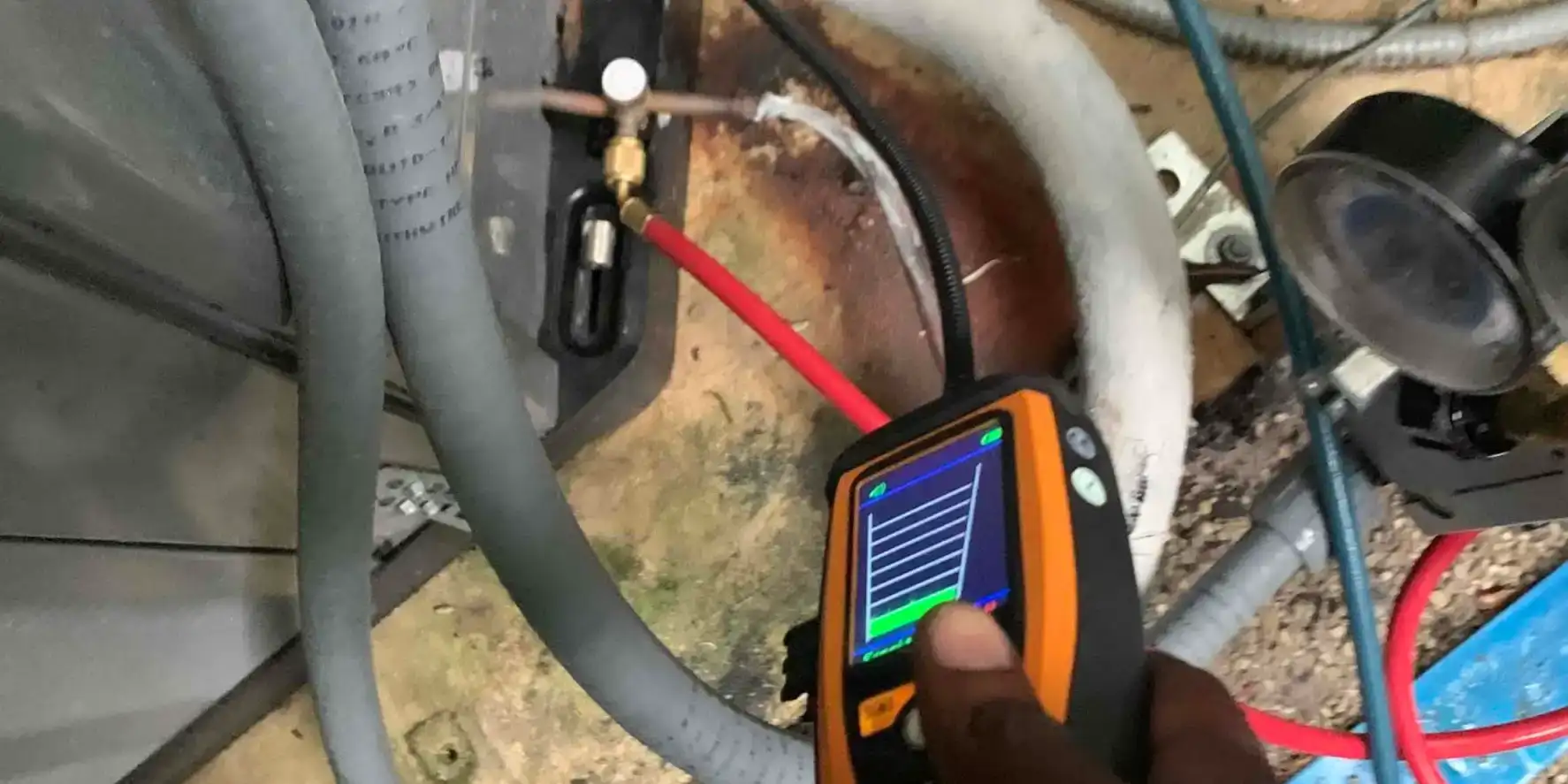
Liberty Air and Electric doesn't run the same leak search on a 14-year-old system and a 2-year-old one. Age changes what an oil stain is worth, and it changes what a deep search is worth paying for. A 14-year-old unit and a 2-year-old one get handled two different ways on the truck.
The 14-year-old system with an oil stain
A 14-year-old unit, low on charge, with an old oil stain on the evaporator coil. That stain is most of the answer. The evaporator coil is where AC systems leak most often, the system is long out of warranty, and the oil is sitting right on the usual suspect. Could there be a second leak somewhere else? Sure. It wouldn't change the call. At that age and that repair cost, the math shifts to AC replacement, and we're not going to charge hundreds of dollars to prove what a free look already showed. That money does more good on the new system.
The 2-year-old system that checks clean
A 2-year-old system losing charge, and the visual check, the bubbles, and the sniffer all come back clean. If the coils, joints, and valves aren't leaking, what's left is the copper line set. That's not a common failure. One thing raises the odds, though. If the old system was replaced because it ran out of gas, and the installer reused the existing copper, and now the new unit is low too, the line set may have been the leak the whole time. Nobody should open walls or reroute copper on a guess, so that's the call where we run an isolation test.
The isolation test, and the 50% credit
An isolation test valves the system off into sections, pressurizes each one with dry nitrogen, and watches which section drops. On our trucks the readings run through a Fieldpiece SMAN wireless manifold with a built-in vacuum gauge that reads down to 50 microns, so the same rig that finds the leak checks the evacuation after the repair. Done right it takes hours, and on a complex layout it can run $900. That's real money to spend before any repair starts, which is why we have a standing rule. Liberty credits 50% of an isolation test toward the work that follows it. A $900 test becomes a $450 credit on the repair.
Low on refrigerant again?
Book a diagnostic. We'll tell you which search the system needs, and what it costs, before we run anything.
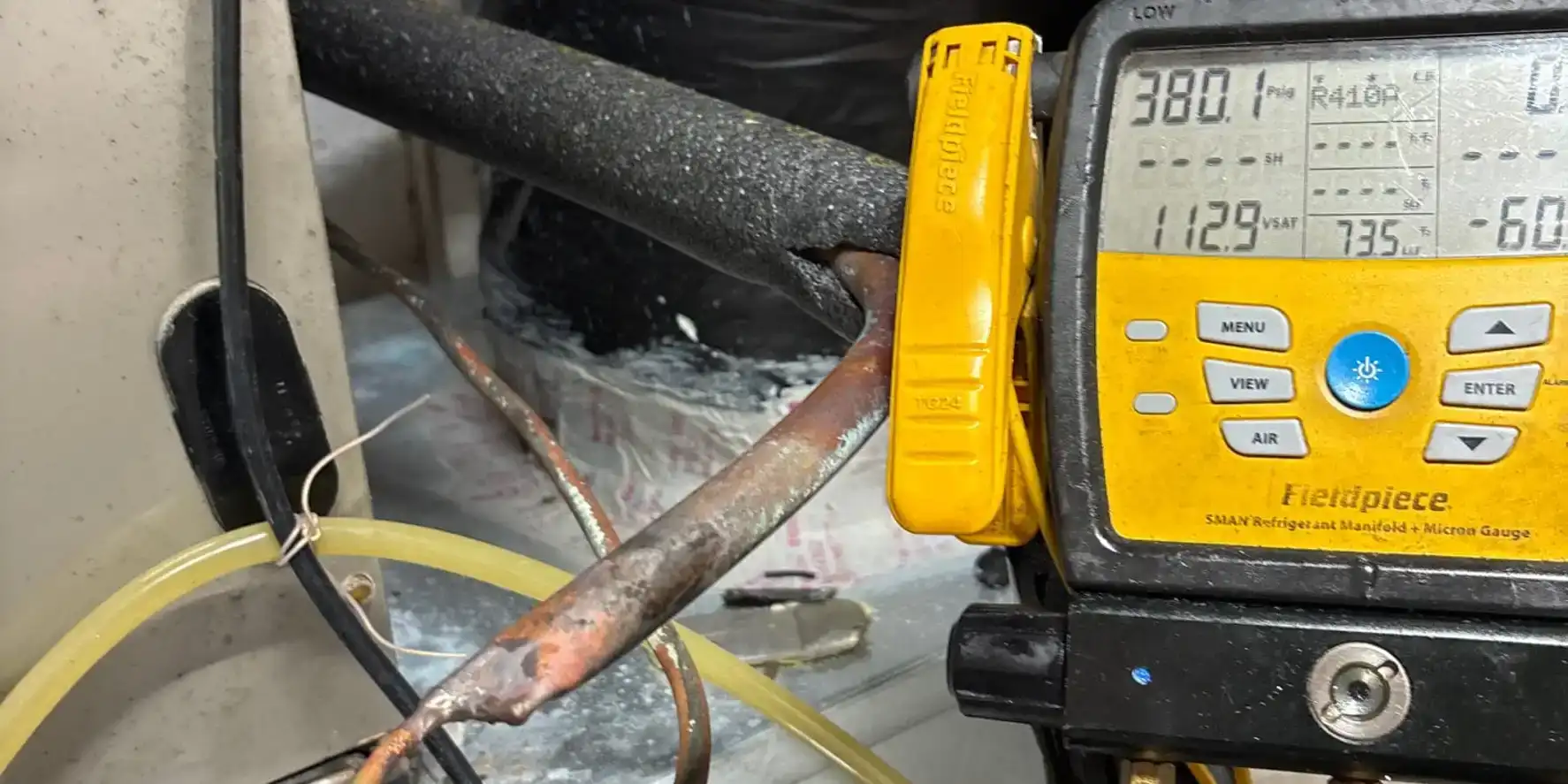
Copper line set leaks are rare in a single-family home and noticeably less rare in Florida condo buildings. The single-family homes Liberty serves in Wedgefield almost never see one. Condo buildings are where the odds change, and the reason is how their line sets get routed. Multiple units' copper often runs into one shared gooseneck and travels a common conduit before branching off to individual apartments. Copper that sits against other copper in a shared chase vibrates a little every time a compressor kicks on. Give that vibration enough years and it wears through the pipe wall.
The shared routing tells you something else too. When we find a copper line leak in one condo unit, it's often the first of several in the building, because the neighbors' lines have been riding in the same conduit for the same number of years. One confirmed line set leak in a South Florida building is worth mentioning to the association.
Repairing a condo line set is a different job than repairing one in a house. The copper sits inside shared walls and chases, access is limited, and the run belongs partly to the building. Sometimes we can repair or re-run it. Sometimes the routing makes a repair impossible and the fix becomes a conversation with the association, which is the part of condo AC work that sets the schedule. We'll tell you which one you have before any money changes hands.
Service Valve Leaks and the Gauge Habit
Liberty techs find more leaks at service valves than almost anywhere else, and plenty of those got made by somebody's gauge set. Every time a set of gauges connects to the system, the valve cores take a little wear. A careless connection at a maintenance visit can damage a core outright, and a damaged core bleeds refrigerant slowly for months before anyone notices the house running warm.
Plenty of AC systems never need gauges on them at all. If the temperature split reads 15 to 20 degrees and the amp draws are in spec, there's no good reason to hook up. The charge is sealed in. It isn't going anywhere unless something opened a path out, and the numbers already say nothing did. Our rule on AC maintenance visits is to pull a baseline pressure reading the first time we see a system, then leave the valves alone as long as the other measurements stay good. A lot of homeowners expect the gauges to come out every visit, and on most of those visits we leave them on the truck.
If the Gauges Come Out Every Single Visit, Ask Why
A pressure check isn't free. Each connection wears the valve cores, and worn cores are one of the leak sources we get paid to find later. When the temperature split and amp draws are in spec, hooking up gauges puts wear on the valves and tells us nothing the readings didn't. A tech who leaves them on the truck is protecting your charge.
What a Refrigerant Leak Repair Involves
Liberty Air and Electric quotes a leak repair as one job, and the steps are the same every time. The charge gets recovered, the leaking part gets swapped or brazed, the system gets pressure tested, evacuated, and recharged by weight. Around Florida these repairs run $200 to $1,500 depending on where the hole is, and they sit inside our normal AC repair pricing, quoted before any work starts. When the hole is in the coil itself, the job becomes an evaporator coil replacement and the numbers change with it.
Any repair that opens the refrigerant circuit also gets a new filter drier. The drier is the component that catches moisture and debris inside the sealed system, and the moment the circuit opens, both get in. A saturated drier lets moisture turn to acid, and acid takes out compressors. Replacing it isn't a contractor padding the ticket. Every manufacturer calls for it when the circuit gets opened, and it's a cheap part next to what it protects.
Where stop-leak products fit
Sealants fit one narrow spot. An older, out-of-warranty system with a minor leak, owned by someone who isn't ready for the bigger spend of replacement. In that spot a stop-leak product can buy a season or two for a fraction of a repair. We're not opposed to that, case by case. But we'll call it what it is. The leak is still there. When you're ready to price a new system, that's its own conversation. Liberty won't sell a sealant as a permanent fix.
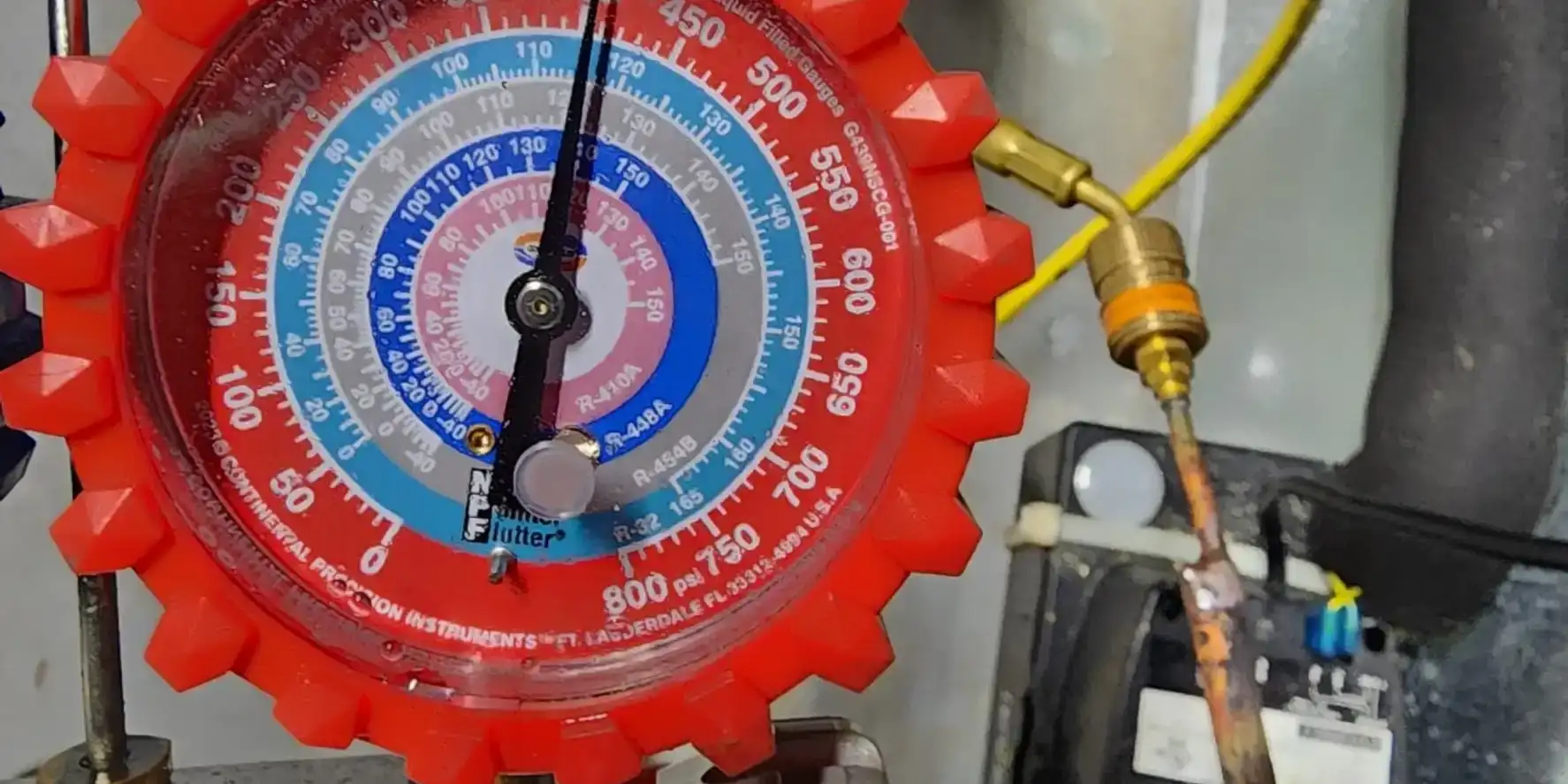
R-32 and R-454B, the refrigerants in new Florida systems, are classified A2L, meaning mildly flammable, under ASHRAE Standards 15 and 34, the safety standards our trade installs to. Because of that classification, A2L installs come with real commissioning tests. The system gets pressure tested with dry nitrogen and held to confirm it doesn't drop, then evacuated to a deep vacuum around 500 microns and watched to confirm the vacuum holds. Every AC change-out in Florida runs through a mechanical permit under the Florida Building Code, and those tests are part of doing the install right.
None of those tests guarantees the system will never leak. A pressure test proves the circuit was tight that day, at that pressure, over that hold time. A pinhole small enough can sit below what a 30-minute test resolves, and the vibration leaks that show up in year 8 haven't happened yet. Nobody cheated the test. That test covers the day it was run, and the system has to hold for 15 years after it.
Questions?
Frequently Asked Questions About AC Refrigerant Leak Detection
Q: How do HVAC techs find a refrigerant leak?
A: HVAC techs find refrigerant leaks with a ladder of methods. Visual inspection for oil stains, soap bubbles on accessible joints, electronic sniffers that smell refrigerant in parts per million, ultrasonic detectors that hear the hiss, and isolation testing that pressurizes the system section by section with nitrogen. Most leaks turn up on the first two or three. The pricier methods are for the ones those miss.
Q: How much does AC leak detection cost in Florida?
A: AC leak detection in Florida often rides along with the diagnostic visit, which runs $49 to $99. When the cheap checks come back clean, a deeper electronic search gets quoted before it starts. A full isolation test is the big one. It takes hours and can run $900 on a complex layout. Liberty credits 50% of an isolation test toward the repair that follows it.
Q: Where do AC refrigerant leaks most often occur?
A: AC refrigerant leaks most often occur at the evaporator coil, where Florida humidity and condensate work on the metal all year. Service valves come next, and a share of those trace back to gauge connections at past service visits. The copper line set is the least common source in a single-family home. Florida condo buildings change those odds.
Q: What is an isolation test on an AC system?
A: An isolation test splits the refrigerant circuit into sections with valves, pressurizes each section with dry nitrogen, and watches which one holds and which one drops. It places leaks that every cheaper method missed, which usually means a leak in the line set itself. We reserve it for systems where the cheaper checks came back clean, because it takes real hours to run right.
Q: Can stop leak fix an AC refrigerant leak?
A: Stop leak products can seal a minor refrigerant leak in an older system, and that's about all they do. A band-aid, not a repair. On an out-of-warranty system with a small leak, that band-aid can carry you a season or two until replacing the system makes sense. We use them case by case, and you'll know exactly what you're buying before we do.
Q: Should the tech check refrigerant at every AC maintenance visit?
A: Refrigerant doesn't need checking at every AC maintenance visit. The circuit is sealed, so if the temperature split and amp draws read right, the charge is doing its job. Every gauge connection puts wear on the service valve cores, and worn cores become leaks. We pull a baseline reading on a first visit, then go by the numbers we can read without opening the system.
Q: Why does my 2-year-old AC have a refrigerant leak?
A: A 2-year-old AC with a refrigerant leak usually traces to a factory coil defect, a braze joint, or a service valve. When all of those check clean, what's left is the one part that didn't get replaced with the system, the copper line set. If the old system died low on refrigerant and the installer reused the existing lines, the leak may have been in the copper the whole time.
Q: Do condo AC units get more refrigerant line leaks?
A: Condo AC units in Florida see more copper line set leaks than single-family homes. Many buildings route several units' line sets through one shared gooseneck and conduit before they branch to individual apartments, and copper that vibrates against copper for years wears thin. One line set leak in a building is often the first of several.
Q: Do you have to replace the filter drier after a refrigerant leak repair?
A: The filter drier gets replaced any time the refrigerant circuit is opened, and a leak repair opens it. The drier catches the moisture and debris that enter with the work, and a saturated drier lets moisture turn to acid inside the system, which sets up the next failure. Manufacturers call for the swap. It's part of the job.